

How can a clear split form within AI-linked names in a single session? Today you see a sharp split: one leader pulls back while a key peer rallies after big-cap spending signals.
In today’s session, nvidia stock falls as much as ~5% intraday and sits about 2.8% lower near 2:41 p.m. ET.
At the same time, Broadcom jumps on Google’s hint of higher capital spending, creating a two-lane move inside tech.
The catalyst: investors are digesting Anthropic’s new Claude developer tool and debating how software monetization may shift. That debate pressures multiples and prompts fresh concerns about crowding in mega-cap AI names.
You should care because this repricing affects your AI exposure, portfolio concentration, and risk management. CEO Jensen Huang addresses the worry at an AI conference in San Francisco, calling the fear “illogical.”
Read on for a market snapshot, the drivers behind the slide, valuation and catalysts, and practical guidance on reading analyst targets and managing your positions.
Key Takeaways
- Today’s action shows a split: one major AI-linked name falls while Broadcom benefits from hyperscaler spending signals.
- The move is active repricing — down ~5% intraday and still lower mid-afternoon — not a slow drift.
- Shifting AI narratives, like Anthropic’s new tool, are changing investor assumptions about software monetization.
- That divergence matters for your AI exposure and risk around megacap concentration.
- The article will cover market context, drivers, valuation, analyst targets, and portfolio management steps.
Market snapshot: Nvidia stock decline deepens as Broadcom climbs on Google capital spending
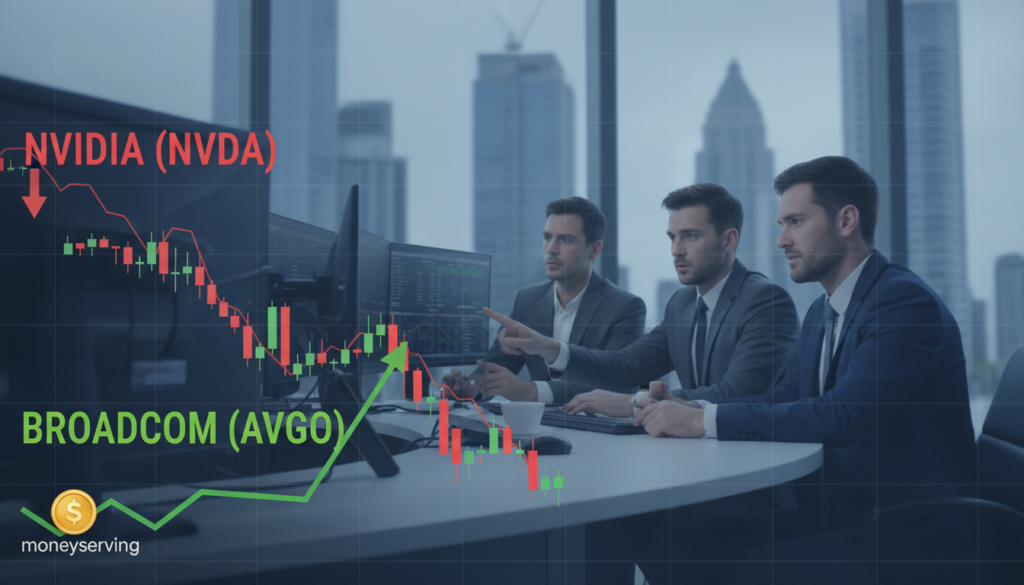
Traders saw a clear rotation between compute leaders and infrastructure plays amid fresh capex news.
What happened in trade and why investors are repricing AI exposure
One major AI name extended losses while a peer rallied, signaling a move from crowded winners to firms with clearer demand signals. The pullback reflects concern that new AI tools could shift where software monetization lands.
Why Google’s capital expenditure plans shifted sentiment toward Broadcom
Higher expenditure plans from Google lifted confidence in suppliers tied to data center buildouts. Increased capex implies more networking and connectivity hardware, boosting firms with direct exposure to those purchases.
How the move fits into the broader tech and S&P 500 backdrop
The rotation comes amid a wider pullback in tech stocks and selective flows in index-heavy names. That context matters: sector risk appetite and Wall Street positioning can amplify single-stock moves beyond idiosyncratic headlines.
Quick read:
- Investors are separating AI demand from AI sentiment.
- Track companies with visible spend pipelines and data center exposure.
| Metric | Compute leaders | Infrastructure suppliers |
|---|---|---|
| Near-term demand signal | Indirect, sentiment-driven | Direct, tied to capex |
| Exposure to Google plans 2026 | Low to medium | High |
| Index impact (S&P 500) | Amplified by flows | Stabilized by contracts |
What’s driving Nvidia’s recent slide beyond the headlines
After an outsized run, you’re seeing traders lock in gains and test how durable sentiment is for a top AI name.
Profit-taking matters because prior momentum delivered huge returns — a recovery that once pushed the forward multiple above 40x and produced roughly an 81% return. With the issue now about ~10% off its peak, even small shifts in narrative prompt selling in a crowded trade.

Valuation and the forward earnings ratio debate
Compression in the forward earnings ratio can drive the price down even when near-term fundamentals look sound. You should treat multiple risk as equally relevant to revenue growth when sizing positions.
AI spending signals and a possible slight slowdown
Hyperscalers announced record expenditure plans 2026, yet markets care about the rate of change. Strong headlines can coexist with a perception of a slight slowdown, which weighs on the stock quickly.
Competitive pressure in accelerators and the broader computing market
Rival architectures and new product cycles can erode pricing power and margins. That risk affects your thesis because execution setbacks or pricing pressure shorten the runway implied by lofty multiples.
“Forecasts that global data center spend could reach $3T–$4T by 2030 support a long runway, but the path will be uneven.”
Realism check: long-term forecasts and trillion annually scale arguments support growth, yet valuation swings and tech weakness mean the stock can correct sharply before fundamentals change materially.
Nvidia stock decline: the catalyst risk investors are watching right now
A surprise tool release from an AI firm quickly shifted sentiment about software demand across the ecosystem.
What the tool does: Anthropic introduced a developer plugin for its Claude model that targets data analysis and tasks in legal, sales, and marketing. The market feared this could automate workflows that many companies pay for today.
How that reignited concerns about software demand
The announcement raised simple questions: will paid software bills shrink if automation handles common tasks? That uncertainty pressured software shares and sent a shock through related names.
Why hardware-first names felt the spillover
Even if a company focuses on chips, when perception of the AI value chain shifts, traders often sell the whole theme. The largest, most owned name can fall sharply as correlation spikes across tech stocks.
Jensen Huang’s response and how you should weigh it
At an AI conference in San Francisco, Jensen Huang called the idea that AI will replace tools “illogical.” He argued breakthroughs expand usage rather than eliminate demand.
“Breakthroughs are about utilizing tools,”
How to evaluate this over time:
- Watch if the new tool changes customer buying behavior and software budgets.
- Track cloud consumption and inference workloads for concrete data.
- Distinguish a headline-driven drawdown from a thesis-breaking signal by checking guidance and enterprise adoption.
Is Nvidia getting cheaper or just correcting? What valuation data suggests
The math behind today’s move comes down to forward multiples and growth expectations into fiscal 2026 and the coming years.
Forward P/E revisiting prior lows and what happened last spring
Forward P/E sits near ~25x today versus about ~24x last spring. After that spring trough the multiple climbed above 40x and delivered roughly an 81% return.
What could re-rate valuation: fiscal 2026 and nvidia fiscal 2027 outlook
Wall Street models a ~63% revenue increase in fiscal 2026 and ~52% in nvidia fiscal 2027 (ends Jan 2027). If that growth holds, multiples could expand and drive higher returns.
Key swing factors to monitor
- China exposure: demand shifts or policy actions will move expectations fast.
- Next-gen architecture rollout: Rubin timing and performance matter for clear product-led re-rating.
- Margin sensitivity: mix, pricing, and supply issues can keep the multiple range-bound.
| Metric | Today | Last spring | Re-rate trigger |
|---|---|---|---|
| Forward P/E | ~25x | ~24x | Sustained revenue beats |
| Revenue growth (fiscal) | ~63% (fiscal 2026 forecast) | Post-spring rebound | Rubin rollouts, China demand |
| Sentiment impact | Range-bound risk | Multiple bottom then surge | Clear guidance, capex signals |
“Long-run global data center capex could reach $3T–$4T annually by 2030.”
Practical takeaway: valuation looks cheaper versus peak, but growth and margins must confirm. If you want risk-managed exposure, scale entries, set downside levels, and wait for earnings confirmation rather than assume mean reversion.
Why Broadcom shares rose as Nvidia fell: the Google capex linkage
Google’s updated capex roadmap gave suppliers a clearer revenue path, lifting infrastructure names while the market trimmed exposure to high-multiple compute leaders.
How capital expenditure plans can lift semiconductor and infrastructure suppliers
When a hyperscaler signals large capital expenditure plans for plans 2026, investors often reward companies that sell the physical gear needed for buildouts.
Those suppliers show more visible order flow and contract timing than firms whose value relies mainly on sentiment. That visibility can translate into steadier revenue expectations.
Data center demand, networking exposure, and why Broadcom benefits
Data center demand is not monolithic. Compute accelerators, networking, and power systems each react differently to spending news.
Networking vendors gain directly when Google commits to new racks and interconnects. That makes them a classic “picks-and-shovels” play.
| Factor | Compute leaders | Infrastructure suppliers | Investor signal |
|---|---|---|---|
| Order visibility | Indirect, timing uncertain | Direct, linked to capex | Suppliers favored |
| Revenue sensitivity | Driven by demand mix | Tied to buildouts | Near-term clarity |
| Typical market reaction | Volatile on multiple moves | Stable on contracts | Rotation to suppliers |
Practical takeaway for your portfolio
Rotate some AI exposure into suppliers to reduce concentration risk. Diversifying between compute and networking helps if announcements outpace actual spend.
“Capex-driven optimism is useful, but watch whether spending converts into revenue and margins.”
Wall Street analysts vs. market action: how to read ratings, price targets, and risk
Analyst ratings are not a single verdict — they map expectations and the uncertainty around them. Use them as one input, not the full decision.
What the current analyst spread implies for expected returns over the next 12 months
The 1-year consensus sits at $264.97, with a low of $200 and a high of $352 across 41 ratings (39 Buy, 1 Hold, 1 Sell).
That spread signals a wide band of possible outcomes. For you, it means expected returns vary a lot depending on growth, margins, and multiple moves.
Why objective drivers matter more than targets when momentum turns
Targets often lag price and sentiment. Focus on hard signals: earnings quality, guidance tone, backlog commentary, and data on data center demand.
If those metrics deteriorate, analysts may cut targets — but the real confirmation comes from the company’s numbers and order flow.
Risk checklist you should track: earnings, guidance, and data center demand indicators
- Listen for revenue growth vs. forecast and margin drivers on the next call.
- Watch guidance language and any changes to backlog or customer mix.
- Track data center purchasing indicators and hyperscaler capex updates.
Portfolio context: managing concentration in megacap tech and AI-themed names
If gains have boosted your exposure, consider trimming to rebalance or adding uncorrelated holdings to reduce single-theme risk.
Set position sizes based on downside tolerance and use staged entries. For retail-focused analysis and community views, outlets like Motley Fool and products such as Stock Advisor can influence sentiment, but base trades on fundamentals and risk controls.
“The analyst spread shows consensus optimism, not a guaranteed return — treat targets as sensitivity markers, not promises.”
For a concise analyst snapshot and price-target context, check this one-year target overview.
Conclusion
Conclusion
Price action separated hype from hard orders: one flagship AI name eased, while a data-center vendor rallied on spend clarity. This divergence matters because it shows the market is actively sorting winners and re-evaluating risk.
Key takeaway: you should treat today’s move as both a risk event and an information signal. Watch upcoming earnings, forward guidance, and whether expenditure plans turn into visible orders that lift revenue.
For your portfolio, size positions to match volatility, avoid over-concentration in megacap tech, and judge the company story over quarters and years rather than intraday swings.